Thursday, March 31, 2011

No worries, Mate!


No worries is used here for all kinds of stuff: "May I have a glass of water? - No worries, mate! I'll bring right over." "Thanks for the help. No worries, mate." Etc, etc.

I take coumadin and fell down and hit my head and now I have a subdural: No worries, Mate! In Tasmania we have Prothrombinex - a Prothrombin Complex Concentrate (that includes factor VII), and in 15 minutes, we've got you're INR back to normal. Comparable to the Octoplex in our study at UCH, but routine here, and has been for a long time. Sure makes this case much more efficient and less hazardous than it would be in the US. (Then again, if she had come in a couple of hours later, a tech would have to be called from home to do the INR in the lab, and another one to do the CT. Interesting mix of real retro care and real advanced care. Oh, we kept her at Lonnie - but with everything geared up to fly her to Hobart if the subdural got bigger and neurosurg would be needed.)

Lots of flying around, and phone calls to handle: "Hi, I'm ..........a GP on Flinder's island (somewhere between Tasmania and Hawaii I think - OK, just a 30minute flight) with a guy with hyertrophic cardiomyopathy and new ischemic sounding chest pain and a bizarre ECG. Can I give him his Plavix load and enoxaparin and GTN (NTG - they reverse the letters since we're upside down on planet earth here) and fly him to you?" Sure, no worries mate. We'll be ready for him.

About 8 PM last night I realized that I hadn't seen another ER consultant for a while and looked around and, it was true it was just me, a couple registrars (one had called in sick) 2 interns and a resident. Turns out that on Thursday the overlap consultant does teaching in the morning and then leaves at 6 PM (for the evening flight back to Melbourne) rather than at 10 PM. So, the evening consultant (me) is responsible for a lot of beds (we've got 17 numbered beds plus paeds, plaster, "theatre", eye, 3 fast track, 2"pit" - kinda in the nursing station, 3 or 4 "chairs", often another bed parked in the middle of the observation area (originally 4 beds but now always 6, and sometimes 7 or 8 if you put a few trolleys in the middle). Somewhere up in the 28 or so beds. Clearly, I don't get a grasp on all that - and don't need to since the more senior of the Registrars function completely independently. The above noted anticoagulated subdural I didn't hear about until about 6 hours later when it was mentioned in passing. No worries, mate.

Then there was the guy with a known 5.5 cm AAA awaiting surgery on it who developed severe back and abdominal pain, looked ghastly, but with a good BP. While arranging a flight to Hobart - which got cancelled after talking with him, his wife, and his son and deciding on comfort care only without surgical care - we did manage to get a timely CT (the CT tech had already been called from home), and sorted out that the AAA wasn't leaking, but one of his gallstones was now in his CBD and his pancreatitis was sitting right on his AAA.

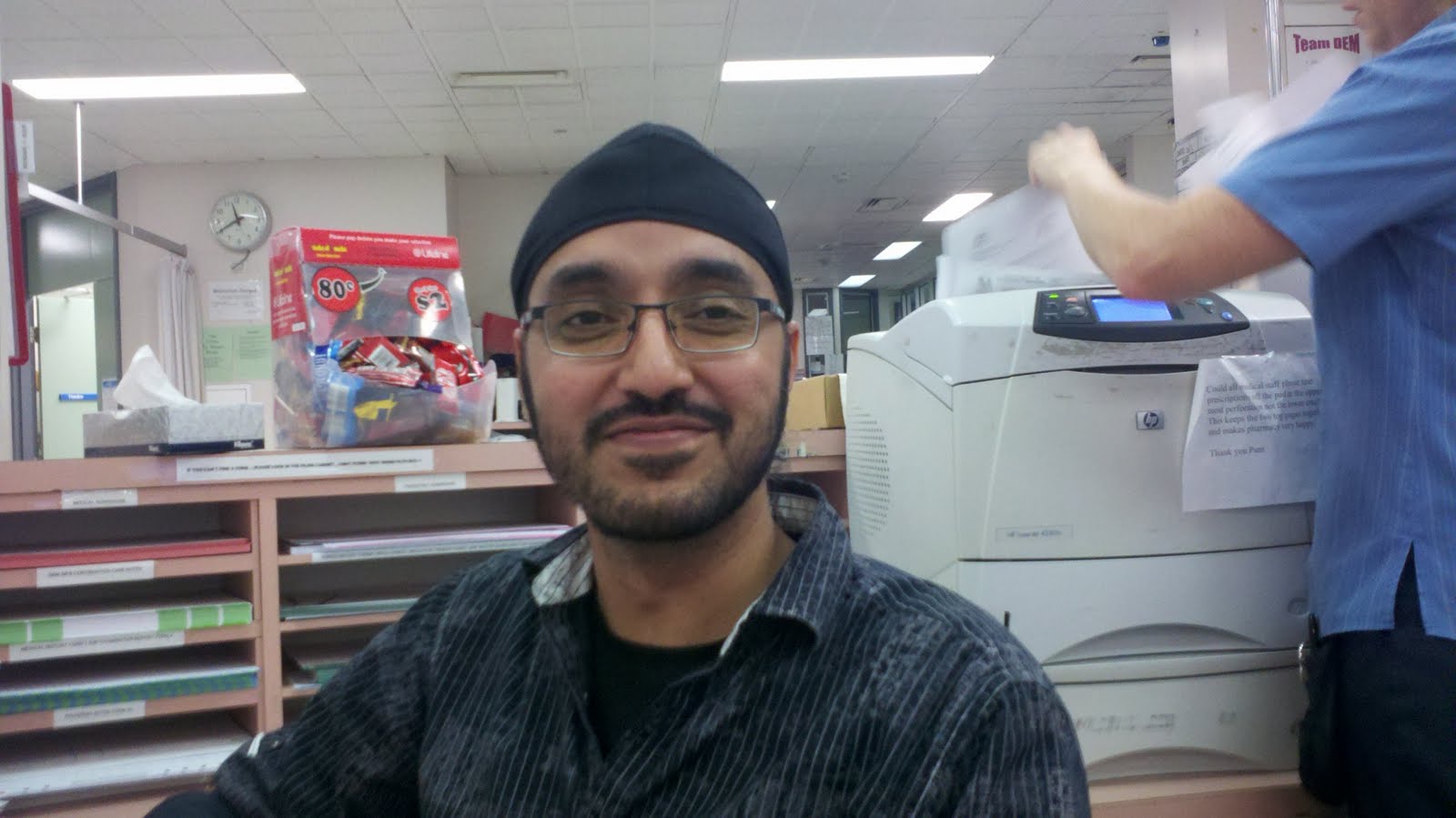
The photos are of two of our interns, and one of our registrars (Kim (pronounced Keeeem) is Australian, Natasha from Singapore, Sushant is our cricket fanatic Indian registrar). Note the working attire - no green scrubs required here, and note the candy bars for sale on the counter behind Sushant.

I always wonder when surgery is taking someone to "theatre" if they will be seeing an opera - Don Giovanni perhaps, or having their gallbladder out.

Pelvic exams are done without stirrups here, works just fine as long as you can find a light (privacy is a bit iffy - especially in the very crowded 6 bed observation area with just curtains and little space between beds). I found some plastic speculums (apparently reused although designed as disposable), but without the plastic light source. Some rooms, the wall light sources on an arm are fine, but in the curtained cubicles, they are at the head of the bed so not helpful. So, I've taken to using the "spotlight" app on my cell phone - actually works quite well - very bright and maneuverable. Thus far it has not rung while in use for this purpose.

Quite a high density of severe pathology here: sick mesenteric ischemia with lactate of 8, severe pulmonary hemorrhage from a lung cancer, lots of central lines, arterial lines, resuscitations, cardioversions - more commonly done than my initial impression, dislocated total hips. Displaced fractures are often done by the ED residents and registrars under supervision of the ortho reg (BTW the fractures needing fixation are admitted for "theatre" within 24 hours - no consideration of insurance status. I don't know the literature, but the ortho reg tells me that there is support for debridement and irrigation of open fractures within a 24 hour time frame rather than the traditional 6 hours, so open fractures are admitted to go to theatre sometime in the next 24 hours).

The bedside blood gas machine is great for stuff like the DKA with venous pH of 6.92 and K+ of only 2.7 where we repleted K and could follow levels every 30 minutes, and delay starting the insulin until we were happy with the serum K level.

No Pyxis machines so it's pretty quick and easy to pull the drugs you need in a hurry and I've quickly learned to use push-dose pressors (metaraminol and phenylephrine) as advocated by Scot Weingart on the EMCRIT website (great site and podcasts on emergency medicine and critical care if you haven't used it).

I didn't know that you could get anaphylaxis from leech bites (as well as Jack Jumper ants). I've seen more anaphylaxis here in a week than I've seen in a couple years.

How about "Oriental cholangiohepatitis" - haven't seen it before, but they get repeat bouts of ascending cholangitis and get quite ill.


Enough.


Tuesday, March 29, 2011

A little on politics

One interesting sidelight of government in Oz is that parliament is not in near-perpetual session as in the US. So, during there periodic sessions (this may not seem so unusual if you consider that the population of the country is smaller than Texas and California, and a wee bit bigger than New York) there is extensive live coverage on radio & TV of the debates and other proceedings of parliament - rather like CSPAN, but with the speeches actually given to a chamber with people in attendance. Yesterday there was a vote on broadband coverage that called for a "division" - a formal vote count rather than just a audible "The Ayes have it." So, the first line from the speaker was "Lock the Doors." Then the ayes line up and walk by on one side of the speakers chair, and the no's on the other side of the chair and are count by 4 "tellers" - 2 from each party.

The current hot topics are a proposed carbon tax, and a proposal for regulation and encouragement of broadband internet service to the country.

In the news, these follow just behind the news that Ricky Ponting resigned as captain of the national cricket team.

One other interesting little tidbit: I can't recall having heard or seen anyone referred to as a wife, husband, or spouse. Partner - both in casual conversation and in news reports. I've been introduced to people's partners, heard of their partners. And, in the news, the businessmen and politicians have partners (including the front page picture of a politician with his hand casually planted on the bum of a young lady who appeared to be about half his age - his "partner").

Off to work.

Medicine

For a physically small ER, we do get a variety of stuff: complete heart block with a ventricular escape rate of 37. Kept his BP reasonable, and his mentation good. Turns out we've got external pacing capabilities, but no pacer wire & box for transvenous. Would have been interesting if he'd been a little sicker and had to be urgently paced.

A flutter at 150 walked in to his GP's office asymptomatic - so no clue how long he'd been in it. But, he was already anticoagulated with a therapeutic INR, so we just cardioverted him. I didn't watch closely enough as the 1st year registrar gave the propofol, and he was "generous" with the dosage - the electrical cardioversion went smoothly, and respiratory status was OK, but took 12 minutes for him to wake up and for his BP to get above 60.

Great deal of interest in this: not sure that cardioversions had been done in the ER in recent memory, and no one had ever used a gloved hand to assure firm contact of the pad to skin.

Ortho was getting slammed, so for his Smith's distal radius fracture that he wanted just a reasonable reduction before admitting him for surgery in the AM, it was quicker to just put that guy down with propofol than to do a hematoma block. We do a lot of sedations here - all with no paperwork! He let our intern have a go at the reduction first, then, in disgust said "You pull like a girl" and then pulled like an ortho (I think they're all rugby players here), and away we went.

Quite a sick DKA with pH 6.93 but a K+ of only 2.7. So wanted lots of K+ on board before we started insulin. But, her precipitant was a submandibular and neck cellulitis and abscess, so put in a femoral line. Then opened the abscess - very little pus, but unusually awful swelling - wonder what the bug will be - presumably an anaerobe. Turned into quite a discussion/negotiation between medicine and ICU registrar as to who would take the patient. ICU/critical care is all done by anesthesia - no medical or pulmonary critical care here - so if the patient doesn't need a vent, ICU typically doesn't want them - treat them in the ER long enough to get them stable enough to go to the floor. Finally did go to ICU (well, sort of, there weren't any beds in ICU or on the floor, so she was staying in the ER for the foreseeable future).

Getting a bit of a feel for the practice styles of the various short term locums consultants - many or most come down and "turn the crank" - so see patients primarily, don't do much teaching, review cases with the junior residents, and on to the next. So, a bit more teaching, supervision, etc style that I'm used to, seems a distinct change and appears welcome.

Saw a "Jack Jumper" ant bite: Jack Jumpers are medium sized ants that grab you with their pincers, then curl their body in a half circle and sting. The sting is reportedly somewhat more painful than a bee sting and much more prone to anaphylaxis than a bee sting. So, there's lots of anaphylaxis from stings here.

The highlight of technology here is the POC (point of care) blood gas machine. Gives pH, pCO2, pO2, K+, glucose, Ca++, lactate, and Hemoglobin - all in a minute or so and gets used regularly. Fantastic when you're taking care of of a really sick patient (4 rounds of these numbers in the first 2 hours with the sick DKA - that let me see that our K and lactate were coming around and heading in the right direction). Further, It's a bit of overkill, but if you need any one of those numbers to get someone out the door - done in a minute instead of waiting an hour, to see if for example, the Hemoglobin is stable. I plan to unbolt it from the shelf and bring it home with me!

Anytime anyone gets near a patient, they put on a disposable plastic apron. Looks like cooking school!

Monday, March 28, 2011

Snakes, food, open water


Recovery ride today, so drove an hour to near the mouth of the river and then took a 50 km ride up to the Bass Strait - 240 km over the water is Melbourne. Trees unlike those at home - and some that are similar. Norfolk pines and eucalyptus remind me of southern California, Huon pines have long needles and massive trunks, then there's stuff that's unrecognizable to me, and rather surprisingly some palm trees.

I got a picture of an Eagle myself for those who were disappointed that I had to steal from Google Images - not very good, but just to prove my point, whatever it might be.

One large snake (probably a Copperhead) wriggling across the road. It was about a meter as it wriggled, so would probably be over 1.5 meters if I caught it and stretched it out. All Tasmanian snakes are poisonous, so I wasn't tempted to measure it, or get close enough for a good picture. On a trail, however was a baby white lipped snake (look close at the picture and you can see the white line along the side of its face). Wikipedia tells me that babies are born in March and are about 10 cm long - the size of this snake. They are only 40 cm when fully grown, and have such small teeth that, although poisonous, usually can't actually envenomate a human.

On the way back, stopped at the Tamar Islands wetlands. The islands remind me of the "hammocks" in the Everglades: lots of tall grass well over my head, with a few forested islands sticking out. The most impressive birds are the black swans which are impressive when swimming or floating, but when they fly turn out to have large white flight feathers on the outer half of their wings which, along with their loooooooong necks, make them truly spectacular (though their necks are so long, I'm not sure how they don't just point straight down when they try to fly).

Food is quite expensive here, though when you add it up, isn't so bad - since the tax (10% GST)is included in the price and one doesn't normally tip - thus you can subtract nearly 1/4 from the listed price to get a comparable US price. Doesn't look quite so bad then. And, some is really pretty good - lots of yuppie restaurants that remind me of Boulder.


Saturday, March 26, 2011

So, they run the Century Rides a bit different in Tassie

First - the ride is 160 km, so no mention of it being a century.

The flyer called for the 160 km starting at 7:30 am (sunrise was 7:22), the 100 k at 9:00, etc.

I'm used to Elephant Rock, Triple, Buffalo, etc with a few thousand riders and starting sometime between "time X and time Y" - so I I didn't make a huge effort to be there exactly 8 minutes after sunrise - and I got lost on the way there, so arrived at the start area at 7:45. Maybe 20 or 30 cars around and nobody on a bike, just a few volunteers.

The route had been changed (because of the floods) adding about 10 Km. So, off I went - not seeing another rider for about an hour. An official came by on a car to tell me that the road closure had been lifted, and the ride back as well as the whole ride for other groups would be on the original route.

Eventually a few guys (who told me they had started early) from the 100 km group came up behind (by that time I was just lollygaging casually along) I fell in with them for a while and then, here comes the peloton! Flying. Maybe 150 to 200 in mostly a double line!

OK, I got it now. These events over here are a mass start and a group gallop. And, I had missed the 160 km group - and they were long gone - thus, the nobody on the road situation.

So, I found a little gap about 2/3 of the way back, stuffed my nose in and sat in. At the turnaround for the out-and-back 100 km ride, there was an aid station. Little city park with bathrooms - which nobody used since there were bushes handy. The aid consisted of glasses of water. Glad I threw in some extra energy bars. Probably explains the surprisingly inexpensive entry fee, also. Oh, and the support vehicle which was a guy on a Harley riding at the front of the bunch.

About 10 minutes later, the gang reformed for the ride back, and I slotted in about the same spot. About 25 km from the end, the pace started to inch upward and on every hill, gaps would appear and since I was pretty far back there were some large efforts needed to close gaps and gradually work up towards the front. By the last 5 km it was pretty much flat out race pace for me, and finally a group of ten took off while I was still about 30 places back - I tried to bridge to them and got caught unable to catch up and stuck in no-man's land. By the time the next couple groups of 5 or so came up, I was cooked so couldn't hang on until the third little group for the flat-out horse race back to the stable.

Averaged 38 km (23 miles) per hour for the 50 km ride back.

So, I missed the full century (ended up with 120 km with the add-ons), didn't get out to the most scenic part of the ride. But, got a great high intensity work out and had quite a lot of fun. Unfortunately, the group was so big and moving so fast that it was really hard to carry on a conversation, so I didn't really get to meet anyone - just a few brief exchanges with folks that I met at the race last weekend.

Kids & stuff

Here's a little something different: Had a little kid, 6 weeks, who had had 2 ALTE's (apparently not common terminology, though the Paeds - yeah that's the spelling here - Reg knew the term for Apparent Life Threatening Event). Baby was attentive and active, but a bit pale and vasoconstricted. Turns out, that the nurses here aren't allowed to even try an IV start in little kids - think the age limit is 6 months or so. I hadn't started a line in one of these kids in many decades, but one of the ER registrars dropped one in 2nd try. IO here is still considered last resort - a bit further down the ladder than in the US. Making the kid cry with the IV pinked her right up, and she was heading off to the ward under care of the Paeds Reg without any definite identified etiology (aetiology to be Australian) when I left.

Doubt that it would be too useful for me to try to relearn that particular skill at this stage of my career.

Procedural sedation is a bit more of a casual event - less paperwork, and a bit more casual a setup than I'm used to.

10 year old kid with bilateral distal radius fractures, one angulated enough to require reduction. Had to take him to "theatre" for the reduction - mostly because "I-I" (Image Intensifier, or c-arm) is used and there's no physical room and/or space to separate it from other ER patients. So, off to the "theatre" where they typical do a quick Propofol general with LMA ventilation (we'd probably do it with Ketamine in the ER). The other difference: in the States, probably get a splint initially, and switch to a cast after swelling no longer an issue. Here, the kid gets a circumferential cast and is hospitalized for 24 hrs to observe and be able to bivalve the cast if needed.

Had a chat with Andrew Hughes, the only other Permanent ER Doc here (half time ER, and half time running the "retrieval service"). There's no standard as far as documentation of supervision of the residents by a consultant. The residents are asked to, and sometimes do, mention in their notes that a case was reviewed with a consultant. I've been using a continuation sheet and putting in a brief note - what we would call the "attending note" at UCH - summarizing the case. Andrew thought that was a really cool idea and far beyond what anyone else is doing. No billing, and few lawyers here, so not strictly necessary.

No ACI's (After Care Instructions). In the US, we've got all kinds of pre-printed legalese crap (in case your heart stops, follow up in sudden death clinic) that might have some useful instructions included. Here, there are a few pre-written instructions that could be printed out, but that I've never seen used. Most patients get only verbal instructions. I've done a couple things: many patients get a "referral letter" to take with them to present to a GP or specialist with whom they follow up. I've sometimes included the instructions (if brief) in the letter, and given an extra copy to the patient. Or, I've pulled up WORD, typed out some instructions and given them to the patient. Of course, there's no documentation in the record - unless you hand write what you included. System could be cleaned up a bit, but I think it's actually better than our system where a patient gets many pages of legal junk and can't find the medically important stuff.

I watched an intern yesterday while she did some pretty simple suturing (after teaching her the relatively recent "single stick" technique for finger anesthesia - if you haven't tried it you should). The mother of the teenager chatted with me about how cool it was that a "senior doctor" actually supervised the junior doctor - something she had never seen done before in her many ER visits - and gave her a lot of reassurance over prior visits when it wasn't at all clear that the intern/junior resident had the skills appropriate to the problem.

Chatting with the residents, it seems that they share that perception: some (maybe many) of the visiting consultants aren't especially attentive with oversight, nor helpful with teaching.

Had a fairly simple straightforward Bell's palsy that none of the interns nor juniors had seen before, and worked well for a quick teaching rounds.

I still haven't seen a patient here who's problem was: "I couldn't find a doctor to see me for this chronic problem." The locals tell me that it happens, but so far, seems rare.


Footy

On today's ride, stopped for a little lunch (seemed to be french fries soaked in grease rather than cooked in oil) at a game of Footy - I believe that's Australian Rules Football. I'm not sure what was going on - there was running, some tackling, a lot of kicking (punting in American style football), and there were an awful lot of people on the field - I believe about 18 per side. Wasn't too crowded, though, since the field appeared to be about the size of a typical 18 hole golf course.

I was surprised to flip on the telly just in time to hear that some guy was going to sing the national anthem before a horse race - and it wasn't Waltzing Matilda! I've been misinformed.